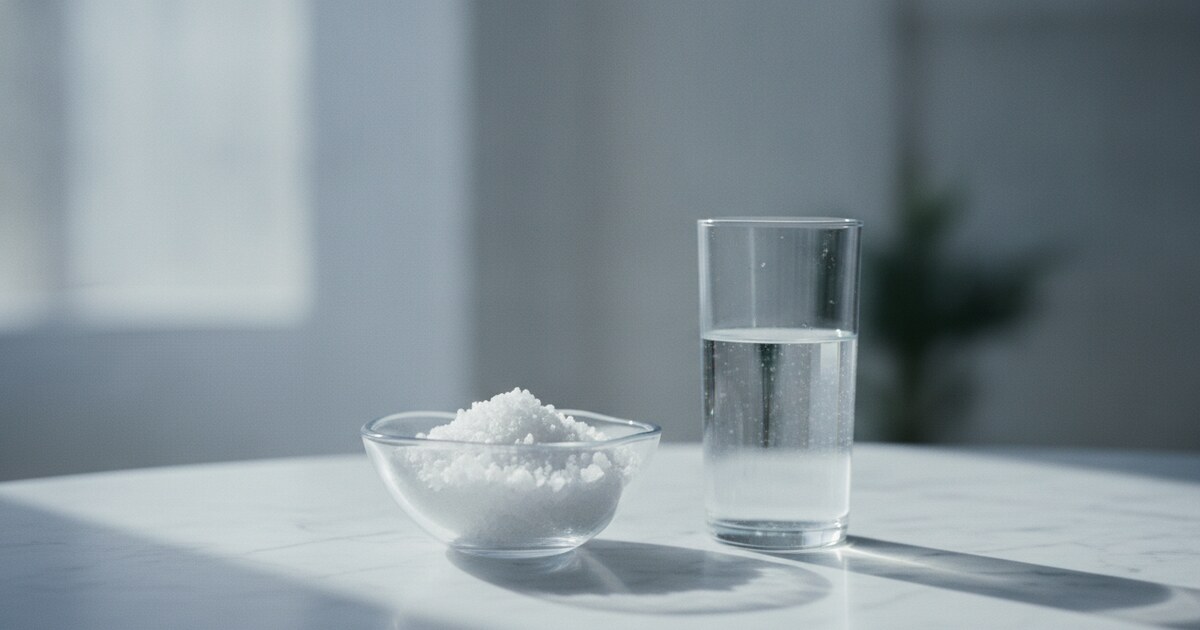
Salt is one of the few things fasting practitioners actively recommend during a fasting window. A pinch dissolved in water, sodium in an electrolyte mix, a dash before a workout session. It seems like consuming anything should count against the fast.
It doesn't. Salt carries zero calories and triggers no insulin response, which makes it compatible with every major intermittent fasting protocol. There's also a strong case for why adding salt during a fasting window makes the experience easier, not just tolerable.
This guide covers the physiology of why salt is fasting-safe, what fasting does to your sodium levels, how much to take and when, and which salt types actually matter. For a complete breakdown of everything that does and doesn't count as breaking a fast, see our guide on what breaks a fast.
Salt doesn't break a fast. Plain salt has zero calories, no carbohydrates, and no protein, so it produces no insulin response and doesn't interrupt ketosis or autophagy. It's compatible with all major protocols, from 16:8 to extended fasts. During a fasting window, sodium needs actually increase because the kidneys excrete more of it when insulin drops.
Why Salt Doesn't Break Your Fast
A fast breaks when caloric intake or macronutrients trigger an insulin response that shifts the body back toward glucose metabolism. Plain salt doesn't meet that threshold.
Sodium chloride contains 0 calories, 0 grams of carbohydrate, 0 grams of protein, and 0 grams of fat. There's nothing in it to metabolize. Adding a pinch of salt to water during a fasting window is metabolically equivalent to drinking plain water, as far as insulin is concerned.
To understand why salt is fasting-safe, start with how insulin drives the process. Fasting reduces insulin levels significantly within 6 to 8 hours of the last meal. A 2018 review published in Obesity (Anton et al.) confirmed that insulin suppression is the primary metabolic switch that moves the body into fat-oxidizing mode. Salt (sodium chloride) contains 0 calories, 0 grams of carbohydrate, 0 grams of protein, and 0 grams of fat. It produces no insulin response because there are no macronutrients to metabolize. The kidneys regulate sodium balance through aldosterone and insulin signaling rather than through salt ingestion. Research by DeFronzo (Diabetologia, 1981) established that insulin directly promotes renal sodium retention, meaning when insulin falls during a fast, the kidneys excrete more sodium in urine. Consuming salt replenishes what's lost without restarting fed-state metabolic signaling. This applies equally to sea salt, Himalayan pink salt, kosher salt, and standard iodized table salt. None contain meaningful calories, and none activate insulin, mTOR, or any pathway that interrupts a fast.
The same logic holds for strict autophagy protocols. Cellular cleanup depends on mTOR suppression through nutrient deprivation. Amino acids activate mTOR; sodium doesn't. Salt is mTOR-neutral and doesn't disturb the autophagy state that extended fasting produces.
What Fasting Does to Your Sodium Levels
When insulin drops during a fast, the kidneys shift how they handle sodium. Normally, insulin tells the kidneys to hold on to sodium. Without that signal, more sodium passes into urine. This creates a mild diuretic effect, particularly noticeable in the first 24 to 48 hours of starting a fasting routine.
At the same time, food disappears. The average American gets around 3,400 mg of sodium per day, mostly from processed foods and restaurant meals. Fasting cuts that to zero. The combination of higher renal excretion and zero dietary intake pulls sodium down faster than most people expect, often within a single day.
This is why the first week of fasting frequently brings headaches, fatigue, and dizziness. These symptoms often get attributed to hunger or caloric deprivation, but sodium depletion drives many of them directly. Understanding this connection changes how you respond: adding salt to water is usually faster and more effective than eating something.
The diuretic effect also explains why fasters often lose several pounds in the first week. Much of that early weight is water bound to glycogen and sodium. As glycogen stores empty and sodium drops, water follows. That's not fat loss; it's fluid regulation.
Signs of Low Sodium During a Fast
Recognizing electrolyte depletion during a fast is useful because the fix is fast and cheap. Common symptoms include:
- Headache: One of the most frequently reported fasting complaints. Low sodium reduces blood volume slightly and affects fluid balance in the brain and surrounding tissue. Our guide on fasting headache covers the full range of causes, but sodium depletion sits near the top for fasts beyond 16 hours. The headache usually appears around hours 14 to 20 of a fasting window.
- Fatigue and brain fog: Sodium and potassium drive nerve conduction and muscle contraction together. When sodium dips, electrical signaling slows down. Fasters often describe hitting a wall somewhere between hour 14 and 18 of a session; this is frequently a sodium issue, not a caloric one.
- Dizziness on standing: Orthostatic hypotension, a temporary drop in blood pressure when moving from sitting or lying to standing, becomes more common when both sodium and total blood volume fall during a fast. Standing up too quickly and feeling briefly lightheaded is a reliable signal to add some sodium.
- Muscle cramps: Less common during 16:8, more common during extended fasts of 24 hours or longer. Low sodium combined with low magnesium and potassium increases cramp risk, especially in people who are physically active or sweat heavily.
One important point: drinking more plain water when these symptoms appear often makes things worse. Water without sodium dilutes whatever sodium remains in the blood, pushing levels down further. A salt-in-water drink addresses the actual problem.
How Much Salt to Take While Fasting
The range most research and clinical practice supports is 1 to 2 grams of sodium per day during an active fasting window. That translates to roughly 1/4 to 1/2 teaspoon of standard table salt.
Table salt is about 40% sodium by weight. A 1/4 teaspoon weighs around 1.5 grams, delivering approximately 575 mg of sodium. A 1/2 teaspoon delivers about 1,150 mg. The NIH Office of Dietary Supplements sets the Adequate Intake for sodium at 1,500 mg per day for most adults, with an upper limit of 2,300 mg. Fasting brings in zero dietary sodium, so replacing part of that range during the window is reasonable.
For a 16:8 protocol on a sedentary day, dissolving 1/4 teaspoon of salt in a large glass of water in the morning covers most people's needs. On active days or in hot weather, where sweat adds to sodium losses, a second serving in the early afternoon helps.
If you're already using an electrolyte supplement during your fast, check the sodium content on the label before adding extra salt, since many products already include 500 to 1,000 mg of sodium per serving. For a full breakdown of electrolyte needs during fasting, see our electrolytes while fasting guide.
Timing within the fasting window matters too. Taking salt early, within the first few hours of the fasting window, helps prevent symptoms rather than treating them after they appear. If you typically fast through the morning, a salt-water drink when you wake up works well.
Salt During Extended Fasts
Sodium needs scale with fasting duration. On a 16:8 protocol, a small amount of sodium in the morning is usually enough. For 24-hour, 48-hour, and 72-hour fasts, sodium management becomes more deliberate.
During extended fasting, glycogen depletion is complete, ketosis deepens, and renal sodium excretion stays elevated throughout. Without any dietary sodium at all, it's possible to lose 1,000 to 2,000 mg of sodium per day through urine alone, plus additional losses through sweat. At this level, muscle cramps, severe fatigue, and significant orthostatic dizziness become real risks.
The practical approach during multi-day fasts: 1/4 to 1/2 teaspoon of salt in water two to three times per day, spaced across morning, afternoon, and evening. Pairing sodium with potassium and magnesium is worthwhile at this level too, since all three electrolytes drop during prolonged fasting and they work together in nerve and muscle function.
For multi-day fasts, salt alone is usually not enough to cover the full electrolyte picture. That's where dedicated electrolyte supplements become worth using. Our extended fasting guide covers the full electrolyte protocol for 24-hour to 72-hour fasts.
Which Salt Is Best While Fasting
All plain salts are fasting-compatible. The differences are narrow and mostly about trace minerals and taste.
- Table salt (iodized): Sodium chloride with added iodine. Iodine supports thyroid function, and iodized salt covers that need for most people who don't eat much seafood or dairy. A reasonable default.
- Sea salt: Minimally processed, slightly coarser. Contains small amounts of magnesium, potassium, and calcium alongside sodium. These trace minerals are fasting-safe and add a marginal electrolyte benefit. The quantities per 1/4 teaspoon are small, so don't count on sea salt to fully replace an electrolyte supplement during extended fasts.
- Himalayan pink salt: Essentially the same composition as sea salt with similar trace mineral content. The pink color comes from iron oxide. No functional fasting advantage over sea salt.
- Kosher salt: Larger crystals, typically no added iodine or anti-caking agents. Fasting-safe. Dissolves more slowly, which some people prefer when stirring into water.
The honest answer: pick the one that tastes best dissolved in water. All of them accomplish the same thing during a fasting window.
How FastFocus Supports Your Fasting Window
Fasting patterns vary. Some sessions move cleanly through 18 hours. Others hit rough patches at hour 14 with a headache or an energy slump. A fasting tracker lets you see whether those rough sessions cluster around specific protocol lengths, activity days, or times of day, which tells you where to add sodium proactively rather than reactively.
FastFocus logs every fasting session with duration, streak data, and weight tracking. Over time, you can see whether certain protocol lengths consistently produce better or harder sessions. That context turns the salt question from guesswork into pattern recognition: add a salt-water drink at hour 12, before the headache, because that's when your data says you need it.
FastFocus supports certified protocols including 16:8, 18:6, 20:4, 5:2, and OMAD, with a visual timer and smart notifications that manage the timing for you. Download on iOS or Android and build a fasting practice that's backed by data.
Frequently Asked Questions
Does salt break a fast?
No. Plain salt has zero calories, no carbohydrates, and no protein. It doesn't trigger an insulin response or pull the body out of ketosis or autophagy. It's fasting-safe across all major protocols. During longer fasts, a small amount of sodium is often actively recommended because the kidneys excrete more sodium when insulin drops, and there's no dietary sodium coming in from food to replace it.
Does Himalayan pink salt break a fast?
No. Himalayan pink salt is sodium chloride with trace amounts of iron, magnesium, potassium, and other minerals. None of these carry calories or trigger insulin. It's functionally identical to table salt for fasting purposes. The trace mineral content adds a small electrolyte benefit but doesn't change its fasting-compatible status.
How much salt should I take while fasting?
Around 1 to 2 grams of sodium per day is a practical range for most fasters. That's roughly 1/4 to 1/2 teaspoon of table salt dissolved in water. On sedentary days during 16:8, one serving in the morning usually covers it. Active days, hot weather, or extended fasts of 36 hours or more call for more. Check any electrolyte supplements you're already using, since many include 500 to 1,000 mg of sodium per serving.
Does salt water break a fast?
No. Salt dissolved in plain water has zero calories and no macronutrients. It doesn't trigger insulin or end a fast. Salt water during a fasting window is a common strategy for managing electrolyte balance and preventing symptoms like headaches and muscle cramps. The only caveat: if you add anything else to the water, like lemon juice, a sweetener, or a flavoring packet, check whether those additions carry calories.
Can too much salt hurt your fast?
Very high sodium intake causes water retention and can raise blood pressure in sodium-sensitive individuals. During fasting, where overall intake is low, that risk stays small for most healthy adults. Staying within 1 to 2 grams of sodium per fasting window is a reasonable ceiling. People with hypertension, heart failure, or kidney disease should discuss sodium intake with their doctor, fasting or not; the same caution applies regardless of the fasting context.
Sources
- Flipping the Metabolic Switch: Understanding and Applying the Health Benefits of Fasting — Obesity / PubMed
- The effect of insulin on renal sodium metabolism — Diabetologia / PubMed
- Sodium: Fact Sheet for Health Professionals — NIH Office of Dietary Supplements