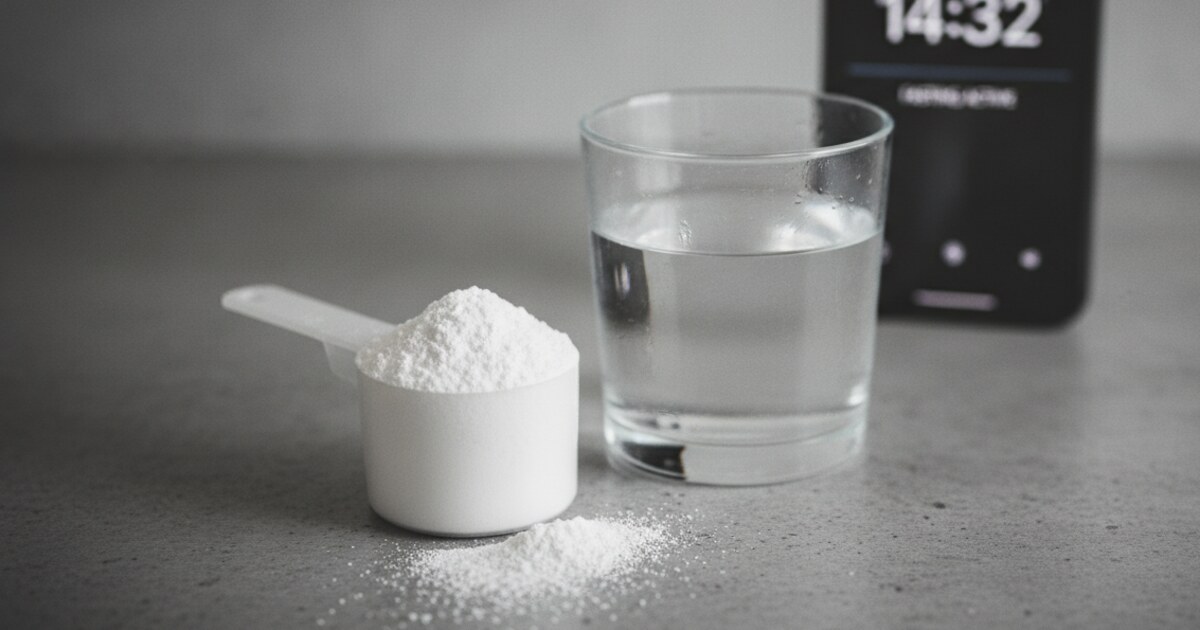
Taking pre-workout before a fasted training session puts you in a genuine bind. You've been fasting for 14 hours, the alarm goes off early, and there's a hard workout ahead. The scoop of pre-workout on the counter looks helpful. Does taking it end your fast, or can you get away with it?
The answer depends entirely on what's in the formula. Pre-workout is a blend of ingredients, and the blend determines everything. Two products with identical branding can have completely different effects on a fast.
This article covers which ingredients break a fast and which don't, how your fasting goal changes the threshold, and how to check your specific product in about 30 seconds. For a broader look at what counts as fast-breaking, see our guide on what breaks a fast.
Most pre-workouts don't break a fast, but some do. The key factors are BCAAs, carbohydrates, and calorie-containing sweeteners. Stimulant-only formulas built on caffeine, beta-alanine, and citrulline are fasting-compatible. Formulas with amino acids, sugars, or caloric sweeteners interrupt your fast regardless of serving size.
What's In Pre-Workout and Why the Blend Matters
Pre-workout supplements fall into two broad categories: stimulant-heavy and amino acid-heavy. Most commercial products mix both. The stimulant side is what fasted athletes usually want: focus, endurance, and vasodilation. The amino acid side is where the fasting problem lives.
The core of most pre-workout formulas contains caffeine (100 to 400 mg per serving), beta-alanine (2 to 6 g), and L-citrulline (3 to 8 g). These three drive the performance effects. None carry meaningful calories, and none trigger an insulin response at standard doses. A growing number of products also include branched-chain amino acids (BCAAs), typically leucine, isoleucine, and valine at 2 to 5 g per serving. BCAAs are protein fragments. At even modest doses, leucine stimulates insulin secretion from pancreatic beta cells and activates the mTOR signaling pathway (the cellular mechanism that suppresses autophagy). A third category includes carbohydrates (2 to 25 g per serving) or caloric sweeteners like maltodextrin and honey, both of which trigger immediate insulin release. For fasting purposes, the distinction between a stimulant formula and an amino acid or carb-loaded formula is the only distinction that matters. A stimulant formula leaves your fast intact. An amino acid or carb formula ends it.
Checking your formula takes 30 seconds. Look at the supplement facts panel for total calories and the ingredient list for BCAAs, EAAs, or any carbohydrate source.
Which Ingredients Break Your Fast
BCAAs and Amino Acids
BCAAs are the most common hidden fast-breakers in pre-workout. Leucine, the most metabolically active of the three, does two things that matter for fasting: it stimulates insulin secretion from the pancreas, and it activates mTOR, the nutrient-sensing pathway that signals cells to shift from repair mode (autophagy) back toward growth.
This means BCAAs break a fast by two separate mechanisms: hormonal and cellular. The insulin effect disrupts metabolic fasting. The mTOR effect disrupts autophagy-focused fasting. A formula containing BCAAs does both, even if its calorie count is technically low.
EAAs (essential amino acids) present the same problem. Some pre-workouts list them as a "performance amino acid blend" rather than BCAAs, but the effect on fasting is identical.
Carbohydrates and Caloric Sweeteners
Any carbohydrate in a pre-workout ends the fast quickly. Common sources: maltodextrin, dextrose, waxy maize, sucrose, honey, and cane sugar. These appear more often in "intra-workout" or "all-in-one" training formulas than in pure stimulant products, but they show up in some pre-workouts too.
Caloric sweeteners follow the same rule. If a serving carries more than around 10 to 15 calories from any source, treat it as fast-breaking for metabolic purposes.
Artificial Sweeteners
Most major pre-workouts use artificial sweeteners (sucralose, acesulfame potassium, stevia) to flavor the product without adding calories. These carry zero or near-zero calories and don't raise insulin in the way carbohydrates do. They're generally considered fasting-compatible, though research on their long-term effects on gut bacteria and insulin sensitivity is still developing. For practical purposes, an artificially sweetened, zero-calorie, BCAA-free pre-workout is fasting-safe.
Which Ingredients Don't Break Your Fast
Caffeine
Caffeine is fasting-safe. It carries zero calories and produces no meaningful insulin response. Its metabolic effects actually complement fasting: research published in Obesity (Anton et al., 2018) confirmed that fasting shifts the body toward fat oxidation through insulin suppression, and caffeine supports that shift rather than reversing it. This is why black coffee is universally accepted as fasting-compatible. A caffeine-only pre-workout operates on the same principle.
Typical pre-workout caffeine doses of 150 to 300 mg also increase adrenaline, which further promotes fat breakdown during a fasted session. If you're already comfortable with black coffee while fasting, caffeine in a stimulant pre-workout sits in the same category.
Beta-Alanine
Beta-alanine is a non-protein amino acid that serves as a precursor to carnosine, the muscle buffer that helps delay fatigue during high-intensity effort. It's not incorporated into protein synthesis pathways the way BCAAs are. It doesn't activate mTOR or raise insulin. The tingling sensation (paresthesia) it produces is a known side effect unrelated to fasting. Beta-alanine is fasting-safe.
L-Citrulline
L-citrulline is an amino acid, but not one of the essential or branched-chain amino acids that activate mTOR. It's converted to arginine in the kidneys, which raises nitric oxide levels and improves blood flow to working muscles. Standard pre-workout doses of 3 to 8 g don't trigger insulin release or disrupt the fasted state. L-citrulline is fasting-compatible.
Creatine
Creatine monohydrate is one of the most studied supplements in sports nutrition. It carries zero calories and doesn't raise insulin. Whether creatine affects autophagy or fasting state is a common question. For the full breakdown, see our article on whether creatine breaks a fast. Short answer: it doesn't.
Your Fasting Goal Changes the Threshold
Not all fasting goals use the same standard for what "breaks" a fast. The two main goals have different thresholds.
For metabolic fasting (weight loss, fat burning): The primary mechanism is insulin suppression. Anything that raises insulin moves you out of the fat-burning state. The relevant question is: does this product contain carbohydrates, calories, or amino acids that stimulate insulin? A stimulant-only pre-workout (essentially zero calories, no BCAAs, no carbs) clears this threshold. Some practitioners use a 10 to 15 calorie ceiling as a practical rule; under that, the insulin response is negligible.
For autophagy fasting (cellular repair, longevity protocols): The threshold is stricter. Autophagy is regulated by mTOR, and mTOR responds to amino acid availability, not just calories. This means a zero-calorie BCAA product can still break an autophagy fast even if it doesn't raise insulin significantly. For extended fasts targeting autophagy, only stimulant-only formulas (caffeine, beta-alanine, citrulline) are truly compatible. If your formula lists BCAAs, EAAs, or any amino acid complex, it's not suitable for autophagy-focused fasting regardless of its calorie count. Research from Laplante and Sabatini (Cell, 2012) established that mTOR senses amino acid availability as a primary input, making even small amino acid doses relevant for autophagy suppression.
For more on fasted training in general, including when to train and how to structure workouts around your eating window, see our guide on intermittent fasting and exercise.
How to Read Your Pre-Workout Label
Check three things, in this order:
- Total calories. Look at the serving-size calorie count in the supplement facts panel. Zero to 5 calories: safe for metabolic fasting. More than 15: treat it as fast-breaking.
- BCAAs or EAAs in the ingredients. Search for "BCAA," "branched-chain amino acid," "leucine," "isoleucine," "valine," or "essential amino acid matrix." Any of these present means the product breaks an autophagy fast. For metabolic fasting, whether it matters depends on the calorie count.
- Carbohydrate grams. If the nutrition facts show more than 0 grams of carbohydrates, the product contains fast-breaking carbs.
If all three checks come back clean (zero or near-zero calories, no BCAAs or EAAs, no carbs), the pre-workout is fasting-compatible for both metabolic and autophagy goals.
How FastFocus Supports Fasted Training
Fasted workouts are one of the main reasons people structure their training sessions around a fasting window. Knowing whether your pre-workout is fasting-safe is part of making that work. Knowing when your fasting window opens and closes is the other part.
FastFocus tracks your fasting sessions with a visual countdown timer, streak data, and detailed session history. You can see at a glance exactly how far into your fast you are when you head to the gym, and whether your planned workout falls inside or outside the fasting window. The app supports certified protocols including 16:8, 18:6, 20:4, 5:2, and OMAD, with smart notifications that manage timing for you.
Download FastFocus on iOS or Android and keep your training and fasting windows in sync.
Frequently Asked Questions
Does pre-workout break a fast?
It depends on the formula. Stimulant-only products with zero calories, no BCAAs, and no carbohydrates don't break a fast. Formulas containing amino acids, sugars, or carbohydrates do. Check the label: total calories, presence of BCAAs or EAAs, and carbohydrate grams are the three signals that determine whether a product is fasting-safe.
Can I take caffeine-based pre-workout while fasting?
Yes. Caffeine carries zero calories and doesn't trigger an insulin response. Most stimulant pre-workouts are built primarily on caffeine, with beta-alanine and citrulline as supporting ingredients; all three are fasting-safe. The issue is any added amino acids or carbs in the same formula.
Does pre-workout with creatine break a fast?
Creatine itself has zero calories and doesn't raise insulin, so it's fasting-safe. A pre-workout containing only caffeine, beta-alanine, citrulline, and creatine is fasting-compatible. The risk is other ingredients in the same formula: BCAAs, carbs, or caloric sweeteners. Check the full label, not just the creatine content.
What pre-workout is safe to take while fasting?
Look for stimulant-only formulas: caffeine, beta-alanine, L-citrulline, and optionally creatine. Avoid anything with BCAAs, EAAs, amino acid complexes, carbohydrates, or calorie counts above 10 to 15 per serving. Checking the ingredient list takes about 30 seconds and gives you a clear answer for your specific product.
Sources
- Flipping the Metabolic Switch: Understanding and Applying the Health Benefits of Fasting — Obesity / PubMed
- mTOR Signaling in Growth Control and Disease — Cell / PubMed
- Dietary Protein and Muscle Mass: Translating Science to Application and Health Benefit — Nutrients / PubMed