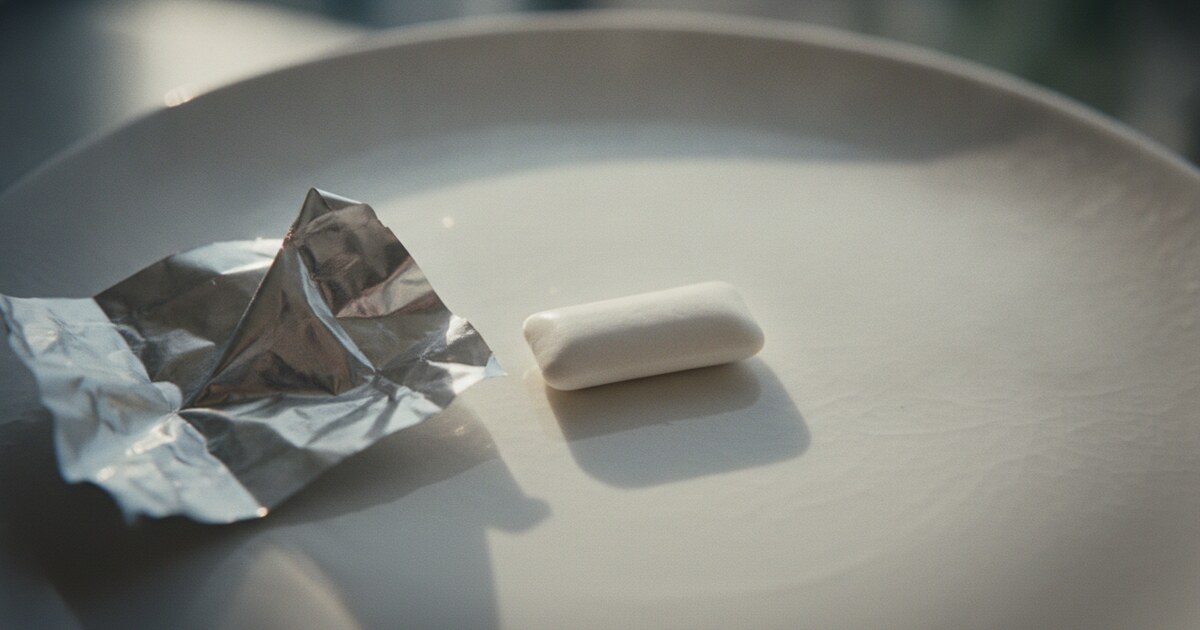
You're two hours into your fasting window and the urge to chew something hits. Sugar-free gum seems like a safe bet. The label says zero sugar, and most sticks list 5 calories or fewer.
Whether that's enough to matter depends on what your fast is actually trying to accomplish. One or two pieces won't meaningfully disrupt a standard 16:8 protocol, but the answer shifts depending on which sweeteners are in the gum and whether you're fasting for weight loss, ketosis, or cellular repair.
For a full breakdown of what crosses the threshold for breaking a fast, our guide on what breaks a fast covers the calorie and insulin thresholds across all major protocols. This article focuses specifically on sugar-free gum: the sweeteners, the cephalic phase response, and how your fasting goal changes the answer.
Sugar-free gum contains 2-5 calories per stick, mostly from sugar alcohols like xylitol or sorbitol, which have a minimal effect on blood glucose and insulin. For weight loss and metabolic fasting, one to three pieces won't break your fast. For strict autophagy fasting, the conservative choice is to skip it.
What's Actually in Sugar-Free Gum
Most sugar-free gum draws on two types of sweeteners: sugar alcohols and artificial sweeteners, often combined in the same product.
Sugar alcohols are the primary calorie source. Xylitol and sorbitol are the most common. Xylitol carries about 2.4 calories per gram; sorbitol comes in around 2.6 calories per gram. A standard stick of gum contains 1.1-1.4 grams of these ingredients, putting the per-piece calorie count at 2-4 calories. Most labels round up to 5 calories per stick because the FDA rounds anything above 0.5 to the nearest 5-calorie increment.
Artificial sweeteners (aspartame, acesulfame potassium, and sucralose) contribute almost no calories. They're included for sweetness intensity rather than bulk. Orbit, Trident, and most mainstream brands combine both: sugar alcohols for texture and chewiness, artificial sweeteners for flavor.
Xylitol is the most studied ingredient in sugar-free gum for fasting purposes, and the research is reassuring for most people. A 2003 review in Nutrition Research Reviews (Livesey) found that sugar alcohols including xylitol have a glycemic index of 7, compared to 65-70 for table sugar. At the amounts present in one to three sticks of gum, blood glucose and insulin responses are negligible in healthy adults. Xylitol isn't efficiently absorbed in the small intestine; much of it passes to the colon, where gut bacteria ferment it slowly rather than converting it to glucose. This means its effect on insulin secretion is far weaker than an equivalent amount of sucrose would produce. For fasters focused on weight loss, body composition, or metabolic health, the insulin and caloric impact of a stick of sugar-free gum falls well below the threshold needed to interrupt the fasted state. The more important variable in your fast is the consistency of your eating window, not the occasional piece of gum.
Does Sugar-Free Gum Trigger an Insulin Response?
Chewing something sweet sets off what researchers call the cephalic phase insulin response, or CPIR. The brain detects sweetness, anticipates incoming carbohydrates, and releases a small insulin pulse before any food actually enters the bloodstream. It's a preparatory reflex built into human physiology, not a response to actual nutrients.
A study by Teff, Mattes, and Engelman published in the American Journal of Physiology documented CPIR in healthy adults and found it represents roughly 10-20% of the full insulin response to an actual meal. For gum specifically, the CPIR is smaller than for sweet beverages, since almost none of the sweetener crosses the oral mucosa into the bloodstream. It's mostly swallowed with saliva and metabolized downstream.
For practical fasting purposes, this pulse is brief and returns quickly to baseline. Fat burning stalls when insulin stays elevated over time, not from a transient spike that resolves within minutes. The CPIR from one piece of gum doesn't sustain insulin at a level that would interrupt lipolysis or pull you out of ketosis.
One side effect worth knowing: chewing also triggers saliva and digestive enzyme production as part of the same cephalic response. For some people, this primes the gut in a way that intensifies hunger rather than suppressing it. If you find that gum makes your fasting window harder, the CPIR is probably why. Water or plain black tea tends to be more neutral for fasters sensitive to this effect.
What About Autophagy?
Autophagy is more sensitive to caloric input than metabolic fat-burning is. The mTOR pathway, which regulates cellular cleanup and suppresses autophagy, responds primarily to amino acid availability and sustained insulin elevation. Carbohydrates raise insulin; protein activates mTOR directly through amino acid sensing. Fat is the weakest activator of both.
Sugar alcohols fit into a separate category here. Because xylitol is poorly absorbed and mostly fermented in the colon, its mTOR signal is weaker than glucose or amino acids would produce. Research published in Metabolism confirmed that xylitol infusion in healthy subjects caused only a fraction of the insulin response that equivalent glucose doses produced, consistent with its low glycemic index classification.
Even so, the strictest autophagy protocols call for zero caloric input. If you're doing a 24-48 hour extended fast specifically to maximize cellular repair, there's no compelling reason to add the uncertainty of gum. Water, black coffee, and plain tea are the established zero-calorie options with documented fasting compatibility. Our guide on what you can drink while fasting covers the full list by beverage type and fasting goal.
When Sugar-Free Gum Is Fine (and When to Skip It)
The clearest framework here comes down to what your fasting protocol is trying to accomplish.
For weight loss and metabolic health: Sugar-free gum won't break your fast in any practical sense. The 2-5 calories per stick and modest CPIR are well below the threshold needed to stop fat oxidation or significantly raise insulin. Most people doing 16:8 or 18:6 can chew one to three pieces during a fasting window without any measurable impact.
For gut rest fasts: Chewing triggers enzyme and stomach acid production as part of the cephalic response. If your goal is giving the digestive system a complete break, gum works against that even if it doesn't break a fast by calories alone.
For autophagy-focused extended fasts: The strictest protocols call for zero caloric input. One stick probably won't dramatically reduce autophagy, but if you're doing a 24-hour or longer fast specifically for cellular repair, water and black coffee are the lower-risk choice.
For standard 16:8 fasting: Gum is generally fine and often useful in the last one to two hours before the eating window opens. It curbs the urge to break early without meaningfully affecting the fast's metabolic effects.
One practical note: if you're chewing gum habitually across a full 16-18 hour window (4-5 pieces total), the cumulative calories stay low at around 20-25 calories, but they start to add up compared to a single piece. Keeping it to 1-2 sticks if you're tracking closely is reasonable.
Xylitol vs Other Sweeteners: What Matters for Fasting
Not all sugar-free gum uses the same formula, and the sweetener profile matters at the margins.
Xylitol is the best-studied option for fasting purposes. It has the lowest glycemic index of the common sugar alcohols (GI 7), produces a weak insulin response, and has well-documented dental benefits. It inhibits Streptococcus mutans, the bacteria primarily responsible for cavities. Brands like Spry, PUR, and some Trident varieties use xylitol as the primary sweetener.
Sorbitol sits slightly higher on the glycemic scale (GI 9) and is more likely to cause gastrointestinal discomfort at amounts above 15-20 grams per day. A few sticks of gum fall well under that threshold for most people, but it's worth knowing if you're prone to bloating during fasting.
Aspartame and sucralose carry essentially zero calories and don't raise blood glucose or insulin in controlled studies. Some research suggests they may affect gut microbiome composition over time, but the evidence at the amounts found in gum is limited. For most people, one to two sticks per day during a fast is a non-issue.
For a side-by-side comparison of regular gum and sugar-free gum for fasting purposes, our article on whether gum breaks a fast covers both in detail.
How FastFocus Supports Your Fasting Window
Most fasting decisions, including whether to chew gum, come down to knowing where you are in the window. At hour 14 of an 18-hour fast, knowing you have 4 hours left is different from guessing. A visual timer removes that uncertainty.
FastFocus gives you a countdown of your fasting window, streak tracking to keep consistency visible, and detailed session history. You can see at a glance exactly how far into your fast you are, which makes small decisions easier to judge against your actual progress.
The app supports certified protocols including 16:8, 18:6, 20:4, 5:2, and OMAD, with smart notifications that manage timing for you. Download on iOS or Android and track your fasting windows with data.
Frequently Asked Questions
Does sugar-free gum break a fast?
For weight loss and metabolic fasting, sugar-free gum won't meaningfully break your fast. A stick contains 2-5 calories, mostly from sugar alcohols with a glycemic index of 7, which produce a negligible insulin response. For strict autophagy fasting, the conservative answer is to skip it. The cephalic phase insulin response from chewing is brief and small, but zero-calorie water, black coffee, or plain tea remove the uncertainty entirely.
Is xylitol gum better for fasting than sorbitol gum?
Both are comparable for practical fasting purposes. Xylitol has a slightly lower glycemic index (7 vs 9 for sorbitol) and documented dental health benefits, inhibiting the bacteria that cause cavities. Sorbitol is more likely to cause gastrointestinal discomfort at higher amounts, typically above 15-20 grams per day. For casual gum use during a fasting window, the difference between the two is small.
Can you chew gum during a water fast?
A strict water fast means water only. If you're doing a therapeutic or extended water fast specifically for autophagy, skip the gum. For a standard intermittent fasting protocol like 16:8, the term 'water fast' is often used loosely to mean no food, and sugar-free gum is generally accepted in that context. The distinction matters most for multi-day fasts where the goal is maximizing cellular cleanup.
Does chewing gum while fasting make you more hungry?
For some people, yes. Chewing triggers the cephalic phase response, where the brain and gut prepare for incoming food by releasing digestive enzymes and a small insulin pulse. This priming effect can intensify hunger signals rather than suppress them. If you notice gum makes your fasting window harder rather than easier, that's a well-documented response. Water or plain black tea tends to be more neutral for fasters sensitive to this effect.
How many pieces of sugar-free gum can you have while fasting?
Most fasting practitioners keep it to 1-3 pieces per fasting window. At 5 calories per piece, three sticks adds 15 calories, well below any threshold that would meaningfully impact fat burning or insulin. Going above 5-6 pieces starts to add noticeable calories and increases the risk of gastrointestinal discomfort from accumulated sugar alcohols. For the occasional piece to manage hunger or freshen breath, gum fits comfortably within a standard fast.
Sources
- Cephalic phase insulin release in normal weight males: verification and reliability — American Journal of Physiology / PubMed
- Health potential of polyols as sugar replacers, with emphasis on low glycaemic properties — Nutrition Research Reviews / PubMed
- Flipping the Metabolic Switch: Understanding and Applying the Health Benefits of Fasting — Obesity / PubMed